Satellite IoT on Smart Cities: Enhancing Connectivity & Building a Sustainable Future
Smart cities, the future urban centers, are rapidly evolving through the integration of Internet of Things (IoT) technologies.
These advanced digital ecosystems leverage a network of connected devices to manage and optimize city services and infrastructure, enhancing the quality of life for residents and promoting sustainable urban development.

At the cutting edge of this transformation are developments in Satellite IoT, which expand IoT’s reach beyond the limitations of traditional terrestrial networks, offering a new breadth of connectivity across extensive and remote areas.
Apogeo’s LoRa Technology can provide a smart sensing and control infrastructure, which can allow cities to collect and analyze data from thousands of connected devices in a streamlined manner, in order to make intelligent decisions about the services they need to offer.
Understanding the Smart Cities
A smart city primarily uses Information and Communication Technology (ICT) to enhance urban life’s environmental, financial, and social aspects. The backbone of a smart city lies in its ICT framework which connects the dots between digital and physical resources.
Municipal authorities utilize real-time data handling from those resources, allowing for efficient management of cities’ infrastructure, reducing costs, and improving the overall functionality that enhances citizens’ lives.
Do we need Smart Cities?
According to the World Urbanization Prospects by the United Nations, globally, more people live in urban areas than in rural areas, with more than 55 % of the world’s population residing in urban areas in 2024.
In 1950, 30 % of the world’s population was urban, and by 2050, 68% of the world’s population is projected to be urban.
The rural population of the world has grown slowly since 1950 and is expected to reach its peak in a few years. The global rural population is now close to 3.4 billion and is expected to rise slightly and then decline to around 3.1 billion in 2050.
Africa and Asia are home to nearly 90% of the world’s rural population. India has the largest rural population (908 million), followed by China (514 million).
The urban population of the world has grown rapidly since 1950, having increased from 751 million to 4.6 billion in 2023. Asia, despite being less urbanized than most other regions today, is home to 54 % of the world’s urban population, followed by Europe and Africa (13 % each).
As the world continues to urbanize, sustainable development depends increasingly on the successful management of urban growth and its infrastructure & resources.
Well-managed urbanization, informed by an understanding of population trends over the long run, can help to maximize the benefits of agglomeration while minimizing environmental degradation and other potential adverse impacts of a growing number of city dwellers.
And here’s why we need smart cities. Smart city technologies offer the possibility to achieve these improvements, as they can advance city operations and improve the overall quality of life among residents.
Smart Cities Market
Global sales of smart cities IoT are anticipated to increase significantly, with a projected peak of US $ 72.52 billion in revenue by 2024. From 2024 to 2029, this increase is anticipated to continue at a compound annual growth rate (CAGR) of 9.72%.
The market volume is therefore expected to reach US $ 115.30 billion by 2029. With an estimated revenue of US $ 29.19 billion in 2024, China is predicted to lead the global Smart Cities market in terms of revenue generation.
In the global market, South Korea and Singapore are setting the standard for smart city implementation.
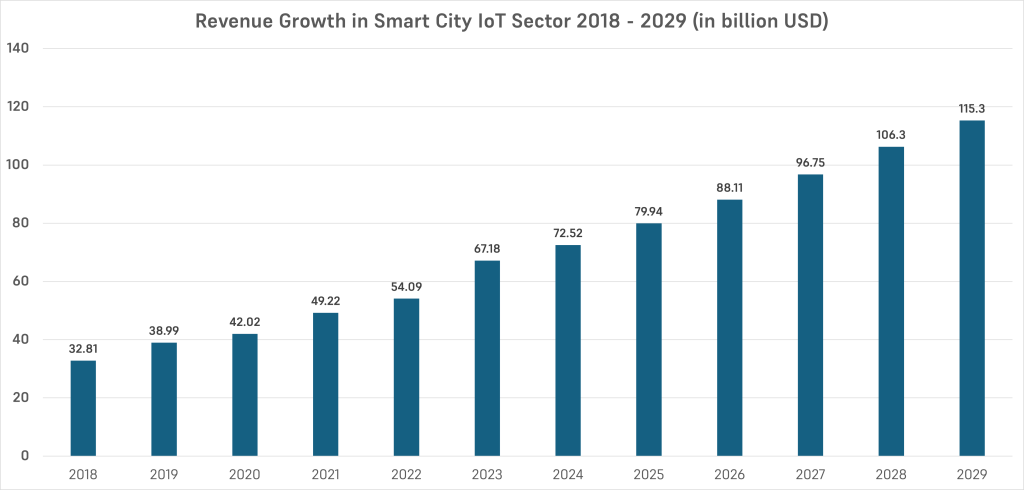
Data Source: Statista
Benefits of implementing Satellite IoT in smart city infrastructure
Satellites play a vital role in providing robust and reliable connectivity to support smart city infrastructure. In the age of the Internet of Things, where millions of devices are interconnected and exchanging data in real time, satellites ensure that these devices remain connected at all times.
Whether it be smart metering or smart thermostats in homes, connected streetlights on city streets, or sensors monitoring traffic and public utilities, satellites provide the necessary bandwidth and coverage to support seamless communication and data transmission.
One of the key benefits of satellite IoT technology in smart cities is its ability to support emergency response efforts. In times of crisis, when terrestrial networks may be down or severely damaged, satellites serve as a critical lifeline, keeping first responders and city officials in communication with one another.
This capability is essential for coordinating rescue efforts, maintaining infrastructure during disasters, and ensuring the safety and well-being of those needing assistance.
Also, a smart sensor infrastructure of smart metering, gas metering, water metering, and wireless leak detection can combine to provide billions of dollars in operational savings and also can reduce energy consumption. Leveraging Apogeo’s LoRa Technology, utilities companies, or system integrators can monitor rural homes, check device status from work, and eliminate the need to send out workers into the field to search for problems.
Moreover, satellites are also playing a crucial role in helping cities combat air pollution. By utilizing satellite data and imagery, cities can monitor and analyze air quality in real time, allowing them to take proactive measures to reduce pollution levels and improve environmental sustainability.
This data-driven approach to air quality management not only helps protect public health but also contributes to the overall sustainability of smart city development.
Besides these:
- Waste Management: Smart garbage systems notify management when containers are full, optimizing pick-up schedules.
- Parking Management: Smart parking systems can provide a robust connection between a network of vehicle occupancy sensors and a Cloud-based management system, where LoRa Technology enables operators to optimize occupancy, reduce operating costs, and help calm traffic congestion in rural, urban, industrial, and commercial environments.
Conclusion: Shaping the future of smart cities with Satellite IoT
In conclusion, Satellite IoT technology has already begun revolutionizing smart cities by enhancing connectivity, sustainability, and scalability.
As we look ahead, it is evident that this innovation will continue to play a key role in shaping a more efficient, interconnected, and sustainable future for urban areas worldwide.
By harnessing the power of Satellite IoT, smart city stakeholders can ensure that their infrastructure is not only technologically advanced but also environmentally conscious and capable of meeting the evolving needs of citizens.
Stay informed and proactive about Apogeo’s Satellite IoT advancements to be at the forefront of creating smarter, more resilient cities that are ready to embrace the challenges and opportunities of tomorrow.